What Are Amniotic-Based Products?
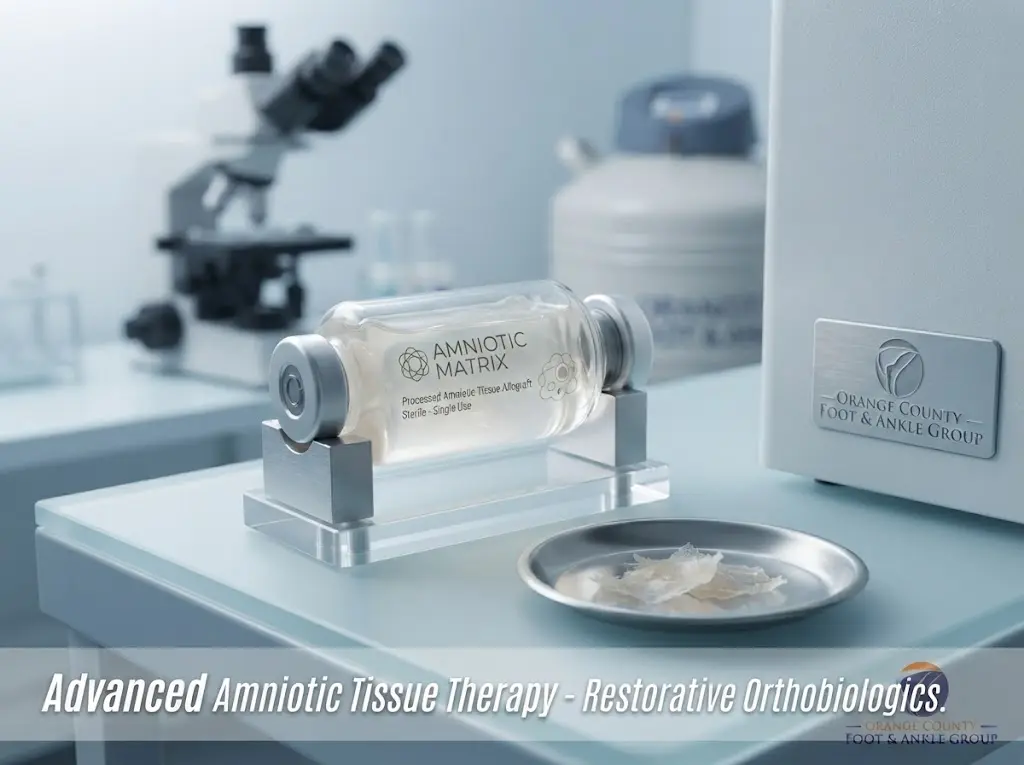
Amniotic-based products are derived from donated birth tissue, such as the amniotic membrane or amniotic fluid. These tissues contain biological components that have been studied for various medical applications.
Products differ in how they are collected, processed, preserved, and manufactured. As a result, one amniotic-based product should not be assumed to have the same composition, intended use, or clinical evidence as another.
Some products are used in established medical applications, while others are marketed for musculoskeletal conditions. The fact that a product is derived from amniotic tissue does not establish that it can regenerate cartilage, repair tendons, or treat arthritis.
How Are Amniotic-Based Treatments Used in Podiatry?
The role of an amniotic-based product depends on its specific formulation and intended use. Certain products have been used in wound care, while others have been investigated or marketed for musculoskeletal applications.
For foot and ankle conditions, it is important to distinguish between a product used as a tissue covering or wound-care material and a product administered by injection. These are not interchangeable applications, and the evidence and regulatory requirements may differ.
Your podiatrist will explain the specific product available at Orange County Foot & Ankle Group, how it is intended to be used, and whether there is an appropriate clinical and regulatory basis for considering it for your condition.
What Conditions May Prompt a Discussion About Amniotic-Based Products?
Amniotic-based products have been studied or marketed for a variety of conditions, but that does not mean they are established treatments for every condition.
Depending on the specific product and its intended use, your podiatrist may discuss whether an amniotic-based option has a role in care for certain wound-related or musculoskeletal concerns.
Diabetic Wound Care
Certain amniotic membrane products have been used as part of advanced wound-care approaches for select diabetic foot ulcers. Their use depends on the product, wound characteristics, and the overall treatment plan.
Appropriate wound care also requires evaluation of factors such as circulation, infection, pressure, and the patient's overall health. An amniotic-based product is not a substitute for addressing these underlying concerns.
Chronic Soft-Tissue Conditions
Amniotic-based products have also been investigated for certain chronic musculoskeletal conditions. However, evidence varies by product and indication, and many marketed injection-based uses have not been established as safe and effective through adequate clinical research.
Your podiatrist can explain whether the specific product available at the practice has an appropriate role in your care and what alternatives should be considered.
Amniotic-Based Treatments vs. PRP
Although both may be discussed under the broad term regenerative medicine, amniotic-based products and PRP are different.
PRP is prepared from a sample of the patient's own blood and contains a concentrated portion of platelets. Amniotic-based products are derived from donated birth tissue and vary in their composition and processing.
Neither treatment should be assumed to contain living stem cells or to regenerate damaged tissue. Their potential uses, evidence, risks, and regulatory considerations must be evaluated separately.
A Personalized Approach to Your Care
At Orange County Foot & Ankle Group, we begin with an accurate diagnosis and a discussion of your symptoms, medical history, previous treatments, and goals.
Your podiatrist will examine the affected area and may recommend diagnostic imaging or additional testing when clinically indicated. We will then discuss appropriate treatment options based on your condition.
If an amniotic-based product is being considered, we will explain the specific product, its intended use, available evidence, potential risks, and alternatives. Our goal is to help you understand whether the treatment is appropriate rather than assuming that a biologic product is automatically the best option.
What to Expect During Your Consultation
- 1. Understand Your Diagnosis
We will evaluate your symptoms and identify the condition contributing to your foot or ankle concerns. - 2. Review the Specific Treatment
Your podiatrist will explain the amniotic-based product being considered, how it is intended to be used, and what is known about its potential benefits and limitations. - 3. Make an Informed Decision
Receive clear information about the recommended treatment, alternatives, potential risks, and expected follow-up so you can choose the next step that makes sense for you.
What Results Can You Expect?
Results depend on the specific product, the condition being treated, and individual patient factors. Evidence supporting one product or application should not be assumed to apply to another.
No amniotic-based treatment can guarantee pain relief, tissue regeneration, wound healing, or avoidance of surgery. Your podiatrist will explain what outcomes may be realistic for the specific treatment being considered.
Important Safety and Regulatory Considerations
Amniotic-based products are regulated differently depending on their characteristics, processing, and intended use. Some human cell, tissue, and cellular or tissue-based products may qualify for regulation under Section 361 of the Public Health Service Act when they meet all applicable criteria. Other products may require FDA approval or licensure before marketing.
FDA registration, tissue-bank accreditation, or a manufacturer's statement that a product is compliant does not necessarily mean the product is FDA-approved for a particular medical use.
The FDA has warned that many regenerative medicine products marketed for orthopedic conditions, including products derived from amniotic tissue, have not been approved for those uses. Patients should ask about the exact product, its regulatory status, and the evidence supporting the proposed treatment.
Your podiatrist should also discuss potential risks, which may include infection, inflammatory reactions, or other complications depending on the product and method of administration.
Frequently Asked Questions About Amniotic-Based Treatments
They are derived from donated birth tissue, such as amniotic membrane or amniotic fluid. Their composition varies depending on the source material and manufacturing process.
Not necessarily. Amniotic-based products should not be described as living stem cell treatments without product-specific evidence. Many processed products do not contain viable stem cells, and the presence of biological components does not establish that a product can regenerate tissue.
Claims that amniotic-based injections regenerate cartilage have not been established for many marketed products and uses. The evidence and regulatory status depend on the specific product and indication.
There is no general FDA approval covering all amniotic-based products for foot and ankle pain. Regulatory status depends on the specific product and intended use. Your podiatrist should explain whether the proposed treatment is authorized for your condition.
Certain amniotic membrane products have been used in the management of select diabetic foot ulcers. Their appropriateness depends on the specific product, wound characteristics, and overall care plan. Not all amniotic products are intended or authorized for wound care.
PRP is prepared from your own blood, while amniotic-based products are derived from donated birth tissue. They differ in composition, preparation, potential uses, and regulatory considerations.
The experience depends on the specific product and method of administration. Some procedures may cause temporary discomfort, soreness, or swelling. Your podiatrist will explain what to expect with the treatment being considered.
The number of treatments depends on the specific product, condition, and treatment protocol. Your podiatrist can provide a recommendation after evaluating your individual needs.
Coverage varies by product, diagnosis, intended use, and insurance plan. Some wound-care applications may have different coverage considerations than injection-based musculoskeletal treatments. Our team can help you understand the financial information associated with a recommended treatment.
Explore Your Options With Clear Information
Persistent foot or ankle problems can make it difficult to know which treatment to consider next. Orange County Foot & Ankle Group can help you understand your diagnosis and determine whether an amniotic-based product or another approach may be appropriate.
Our team is committed to providing personalized care, realistic expectations, and the information you need to make confident decisions about your foot and ankle health.
Schedule a Consultation